
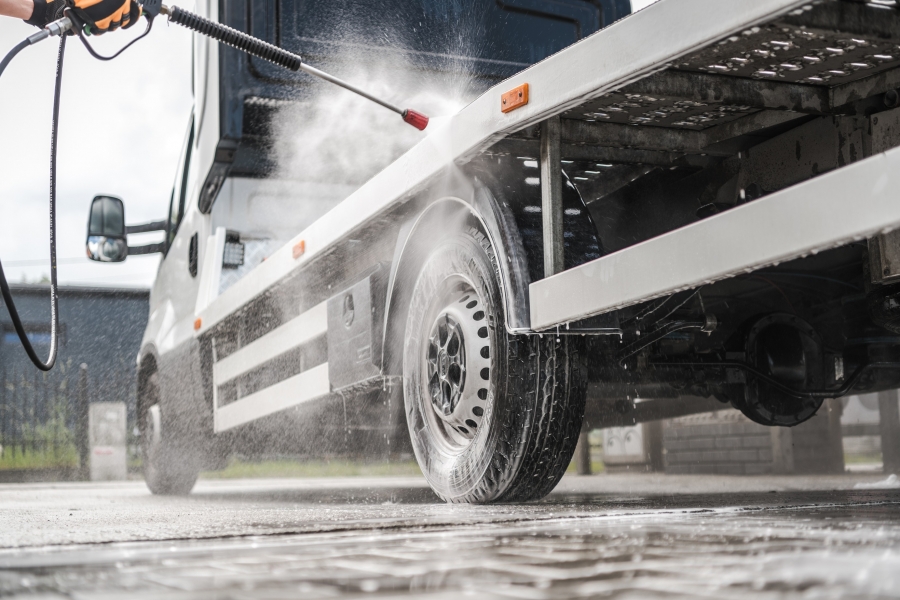
What Makes a Commercial Fleet Pressure Washer Different?
This equipment is built for repeated daily use, longer run times, and back-to-back vehicle cleaning. Fleet washing covers large surfaces such as trailer sides, box truck panels, wheel wells, and undercarriages, often with little downtime between vehicles. That workload requires a pump rated for extended operation and a motor that can run for hours without overheating.
Match PSI and GPM to the vehicles in your fleet:
- Semi-trucks and trailers: 3500 to 4000 PSI, 6 to 8 GPM, for packed road film and salt residue across large surfaces
- Box trucks and cargo vans: 3000 to 3500 PSI, 4 to 5 GPM, enough power without excess water use
- Light fleet vehicles and equipment: 2500 to 3000 PSI, 3 to 4 GPM
Start with your vehicle types, daily wash volume, and available water supply. The largest machine on the lot may use more fuel and water than your operation requires.
Should You Choose a Trailer Mounted or Stationary Pressure Washer?
Fleet truck washing equipment generally comes in two configurations: a stationary unit connected to a dedicated wash bay or a mobile unit that travels between parking areas and job sites. A stationary setup works best when vehicles return to one central yard with enough space for a wash bay and proper drainage. Fleets spread across multiple lots may benefit from a trailer mounted unit that can follow routes through Boulder, Fort Collins, and the I-25 corridor. For mobile washing, tank capacity must cover the expected number of vehicles when a water connection is unavailable.
What Wastewater Rules Apply to Fleet Washing in Colorado?
Wash water carrying detergent, diesel residue, or road salt cannot legally reach a storm drain, a rule that falls under the EPA stormwater program for facilities with industrial activity such as vehicle washing. Route wastewater to an approved sanitary sewer connection or containment setup rather than a storm inlet. Before increasing wash frequency, confirm drainage and disposal requirements with the local wastewater authority serving your facility.
How Does Detergent Injection Remove Diesel Film and Road Salt?
Plain water rarely removes baked on grease or winter residue from frames and wheel wells. Applying detergent through a built-in chemical injector before rinsing gives the solution time to loosen diesel film, salt, and grime. That extra step can shorten cleaning time and reduce the need to rely on maximum PSI for stubborn buildup. Choose an adjustable injector so the detergent ratio can change for road salt, diesel film, or engine grease.
Choose the Right Commercial Fleet Pressure Washer
The right commercial fleet pressure washer reduces cleaning time, helps control corrosion, and keeps your wash schedule moving. Interstate Energy has supplied Mi-T-M systems across Colorado and eastern Wyoming for decades, giving our team firsthand knowledge of the PSI, GPM, and configurations suited to daily fleet use.
Contact us today, and our team will review your vehicle count, wash frequency, water access, and yard layout, then choose a system matched to the work.
```