
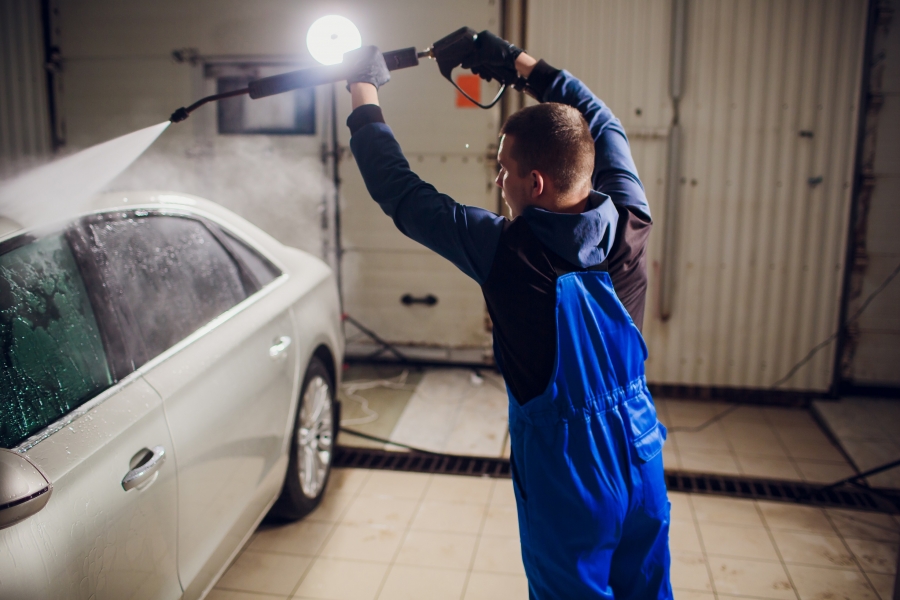
Why Can't You Use a Gas Pressure Washer Indoors?
Gas and diesel engines produce carbon monoxide as a byproduct of combustion, and that gas can build fast in an enclosed space with limited airflow. OSHA limits carbon monoxide exposure to an average of 50 parts per million over an eight-hour workday, with a maximum ceiling of 100 parts per million. In a closed wash bay, a running gas engine can exceed those limits surprisingly quickly.
Electric motors sidestep the problem entirely, since there is no combustion and nothing to vent. Across the industries we serve, food processing, healthcare, retail, parking garages, and enclosed wash bays typically rely on electric equipment because there is no combustion exhaust to manage.
What Electrical Setup Is Best for an Indoor Pressure Washer?
Choosing the right electrical service is just as important as matching PSI and GPM to the cleaning task.
Electrical requirements generally depend on the machine's output:
- Light-duty electric units: standard 120V household circuit
- Mid-range commercial units: dedicated 230V single-phase circuit
- Higher-output hot water electric units: three-phase power, often 230V or 460V
Running a higher-output unit on an undersized circuit can trip breakers, reduce performance, and shorten motor life. Commercial electric units sold in the US are built to meet safety standards covering motor protection, backflow prevention, and high-pressure cleaning equipment. Because these machines operate near standing water, ground-fault circuit protection is also essential.
How Loud Is a Commercial Pressure Washer Indoors?
Noise becomes more noticeable indoors, where sound reflects off walls and equipment instead of dissipating outside. Commercial electric units typically run in the 70 to 85 decibel range, closer to a vacuum cleaner than a power tool. Gas powered units, by contrast, commonly reach 90 to 100 decibels or higher, loud enough to require hearing protection under most workplace noise policies. For facilities running a machine for hours at a time, that difference changes whether hearing protection and noise monitoring become part of the daily routine.
How Do Electric Pressure Washers Heat Water Without Fuel?
Instead of a fuel-fired burner, these units warm water with a heating element or electric heat exchanger. The water passes through the heating chamber on its way to the wand, reaching temperature without any flame or combustion byproduct. This keeps the unit fully electric from motor to heater, which matters for facilities that cannot run any fuel-burning equipment indoors regardless of ventilation. The tradeoff is slower heat recovery, making electric hot water units a better fit for steady cleaning cycles than constant high-volume demand.
Choosing the Right Commercial Electric Pressure Washer for Indoor Use
Choosing the right electric pressure washer for indoor use starts with your facility's electrical service, cleaning demands, and whether hot or cold water makes the most sense for your operation. Interstate Energy has helped businesses across Colorado and eastern Wyoming choose Mi-T-M electric pressure washers for enclosed wash bays, food processing facilities, manufacturing plants, and other indoor cleaning applications.
Contact us today to discuss your facility, available power, and cleaning requirements. We'll help you choose an indoor pressure washer that's matched to your operation.